Postdoctoral research fellow, testing extensions to ΛCDM with large-scale structure data.
I am a postdoctoral researcher at the Institute for Astronomy, University of Edinburgh, working on dark energy and modified gravity theories. I am interested in investigating extended models of the Universe and constraining them with data, particularly from the large-scale structure of the Universe.
I completed my PhD, “Tomographic Coupled Dark Energy with Euclid”, at CEA Paris-Saclay under the supervision of Dr Valeria Pettorino and Dr Martin Kilbinger, studying coupled quintessence models and their potential to alleviate tensions in cosmology.
I am a member of the Euclid Consortium, where I develop the official likelihood code, cloelib and cloelike, and extend its pipeline to constrain models beyond ΛCDM. I am also part of the UNIONS collaboration, where I built the likelihood pipeline for its cosmic shear analysis.
Before my PhD, I completed my Masters in Astrophysics at University College London, with a thesis on Exploring the Cosmological Likelihood of Large Scale Structure as Seen by Euclid under Prof Benjamin Joachimi.
I am originally from the sunny island of Singapore, where it’s summer all year round, so the easiest way to find my office is to look for the one with the heating turned up highest. When I’m not running MCMC chains or solving Boltzmann equations, you can find me with my nose in a book, or at kendo practice!
My research sits between theoretical and observational cosmology. I develop ways to test gravity and dark energy beyond ΛCDM, combining theoretical modelling, large-scale structure observations and machine-learning-assisted inference, so that complex physical models are can be both robust and computationally tractable.
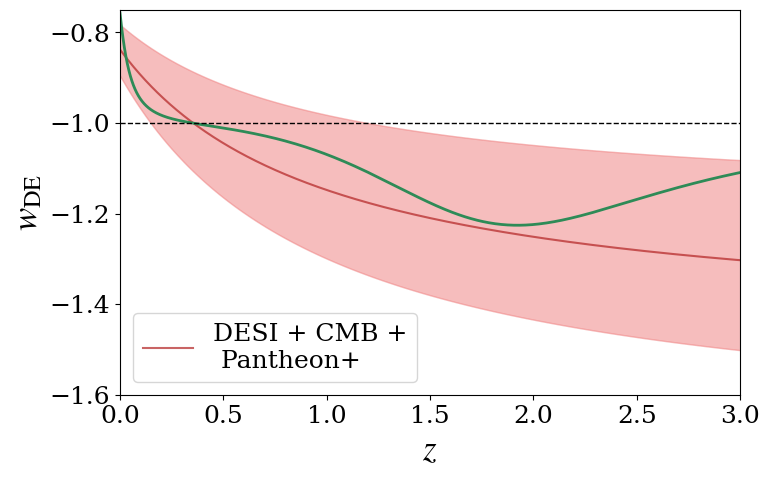
Recent baryon acoustic oscillation (BAO) measurements from DESI hint that the dark-energy equation of state may cross the phantom divide, w = −1. To see whether this can arise from a theoretically grounded model, we studied two-scalar-field quintom models (Goh & Taylor 2025, 2026). With Gaussian or hyperbolic-tangent shared potentials, they realise phantom crossing while remaining stable at both the background and perturbation levels, and they reproduce the BAO distance trends of the w0waCDM cosmology favoured by the data. This offers a possible physical origin for what is otherwise a purely phenomenological parametrisation.
In my PhD I studied coupled dark energy models, in which a fifth force couples dark matter to dark energy, and tested how well it eases the H0 tension when the coupling strength varies over cosmic time (Goh et al. 2023, 2024). We then built a neural network classifier to detect such a coupling directly. On mock fσ8 growth-rate data with DESI-like specifications, it identifies a non-zero tomographic coupling with over 86% accuracy, whichever redshift range the coupling is active in.
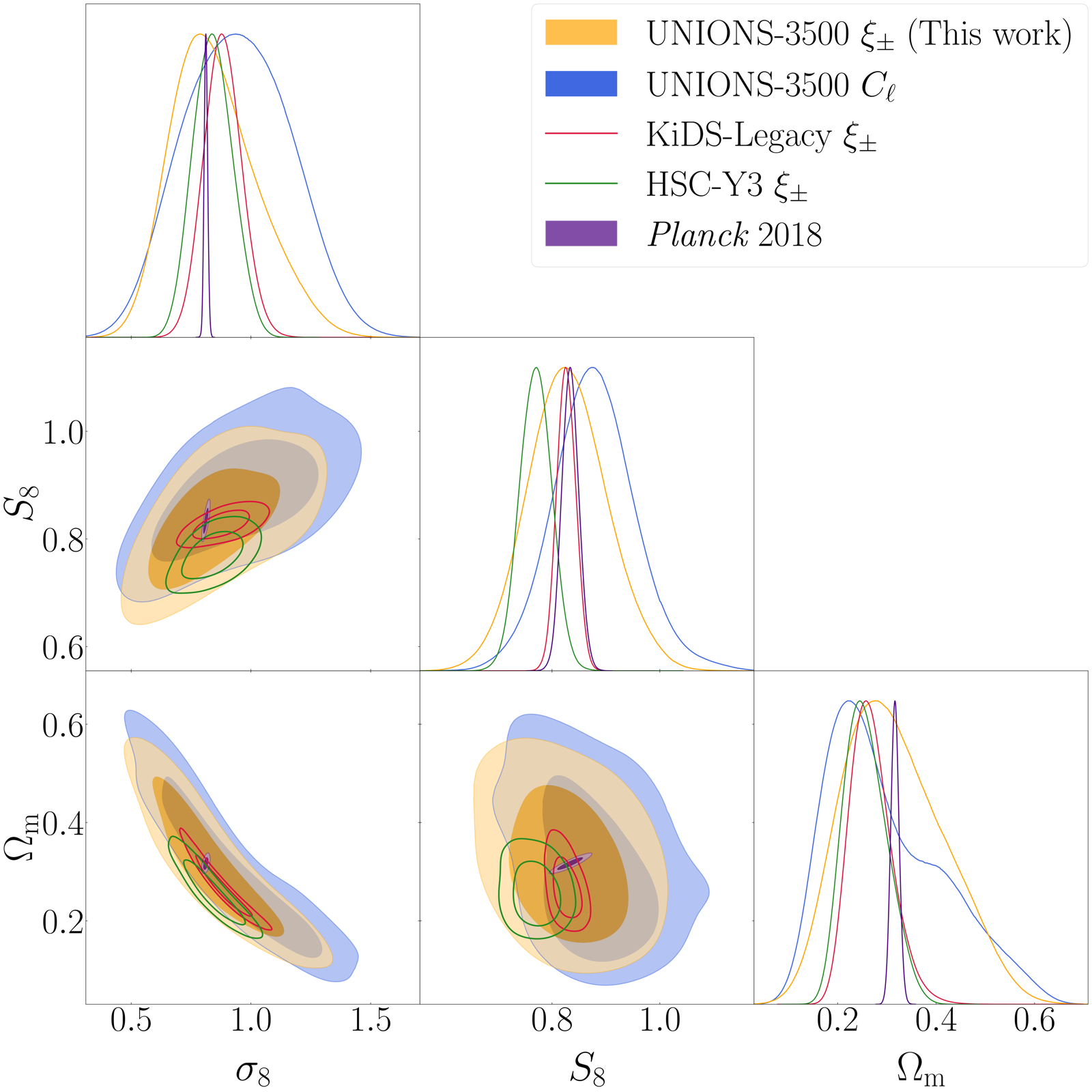
UNIONS, the Ultraviolet Near-Infrared Optical Northern Survey, combines three telescopes in Hawai‘i to map galaxies across the northern sky. I led the configuration-space cosmic shear analysis of the UNIONS-3500 catalogue, from pipeline development and systematics control through to cosmological inference. It produced the first cosmological constraints from UNIONS data in a single tomographic bin, with S8 = 0.831+0.067−0.078, consistent with Planck and previous cosmic shear results within 1σ.
We mitigated systematic effects such as Point Spread Function (PSF) leakage and derived data-driven priors on the intrinsic alignment amplitude and shear calibration bias, showing that the results are robust to inference and modelling choices. The analysis is part of a coordinated four-paper release: check out the other papers describing the catalogue, the B-mode validation, and the harmonic-space analysis.
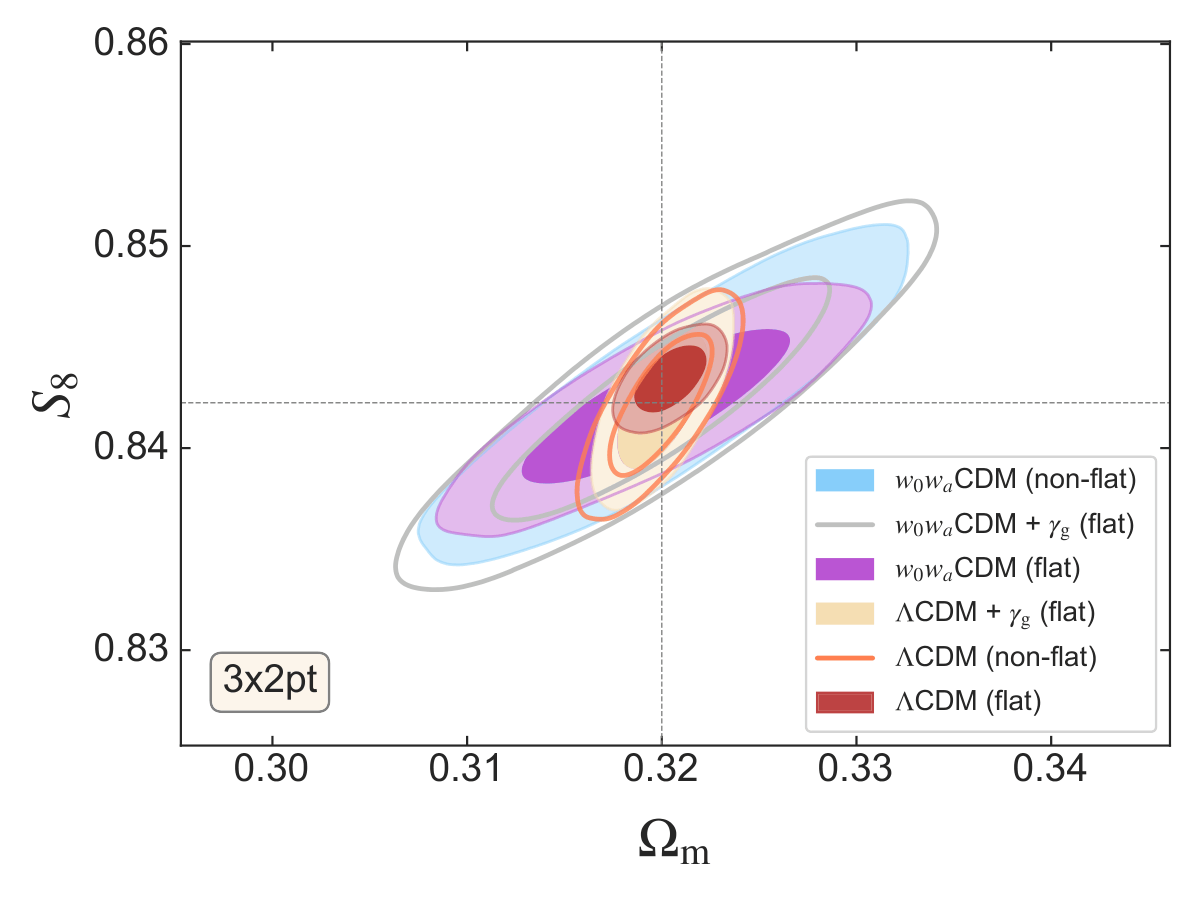
I was a core developer of CLOE, the Cosmology Likelihood for Observables in Euclid, whose development culminated in a six-paper release. I led the paper on extensions beyond the standard theoretical and systematics modelling, implementing magnification bias in the spectroscopic galaxy clustering correlation function, massive neutrinos, and the Weyl potential in modified gravity theories.
I also worked on the Euclid forecasts with CLOE, where machine-learning-assisted sampling made inference computationally tractable. We showed that with Data Release 3 specifications, Euclid is projected to deliver some of the tightest constraints to date on the dark-energy parameters w0 and wa.
I now help develop and maintain the open-source libraries cloelib and cloelike.